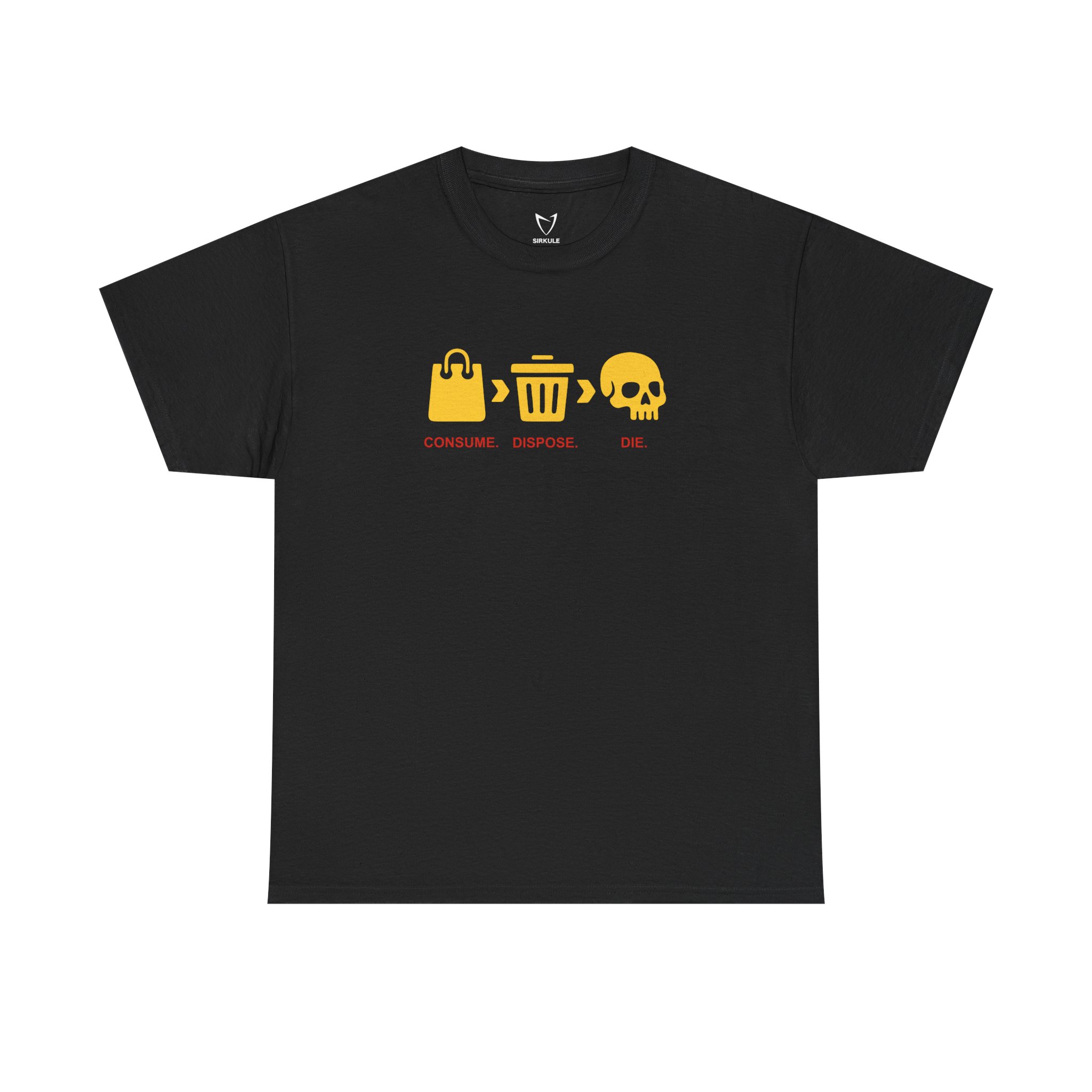


CONSUME. DISPOSE. DIE.
When he was young, Raka used to run to
the toy store at the end of the alley
with a single purpose: to look at the
box.
Not the contents. The box itself.
Glossy paper. Bright colors. Sharp edges.
Text that shimmered under the store
lights. There was something about an
unopened box that felt like a promise
that inside it, everything was still
perfect. Unbroken. Undirtied. Unthrown.
His mother said: "That's not for you.".
But the box was bought two weeks later.
Because Raka had been good. Because Raka
hadn't complained. Because there was a
discount.
The box was opened in twenty minutes.
Two weeks later, what was inside it lived
under the bed. Forgotten.
Thirty-two years later, Raka stood in
front of a wardrobe that could barely
close.
He counted. Twenty-three pieces he had
never worn more than three times. Seven
still with tags attached. Three he had
bought because he'd seen them in an ad
and felt somehow lesser without them.
On the other side of the city, one family
generated textile waste each month equal
in weight to a small child's body.
Normally, nobody counted.
On the other side of the earth, a river
had changed color: blue, then green,
then deep brown from the dye runoff of
factories making the clothes we call
affordable.
Raka didn't know any of this.
Or maybe he did.
But knowing and feeling are two very
different things.
The strange thing about this habit is not
that we are cruel. Not that we don't
care.
The strange thing is how natural it all
feels.
We are born into a system already in
motion. We are taught that buying is a
form of love, treat yourself, treat
others. We are surrounded by images
insisting that having more is a better
identity. And we are never truly asked to
stop and ask: where does all of this go?
The answer has always been there. But
always somewhere we don't look.
In deep holes in the ground.
At the bottom of the sea.
In the air that quietly absorbs
everything we burn and discard.
There was a night Raka could not sleep.
Not because of work stress. Not because
of a complicated relationship. But
because he had read something numbers
he'd looked up himself, with nobody
forcing him about how much clothing is
produced every year, how much never gets
worn, and where the rest ends up.
He put down his phone. Stared at the
ceiling.
And for the first time in a very long
time, he felt something he struggled to
name.
Not guilt too simple for what it was.
Not sadness, too passive.
Something in between. A kind of
accountability he realized he had never
fully accepted.
He thought: we all know where this cycle
leads. We buy. We use. We discard. We
repeat. Fast. Continuously. Without
pause. Without question.
And at the end of the cycle we have
normalized, something we refuse to look
at, but which is always there.
The next morning, Raka opened his
wardrobe again.
He took things out one by one. Folded
what was still wearable. Set aside what
was not. He didn't know this would save
anything. He wasn't pretending that one
small act would reverse something that
had been in motion for generations.
But there was something in the act itself
in pausing, in paying attention, in
choosing consciously, that felt like
responding to something he had long
ignored.
He couldn't change the past. Everything
already discarded was gone. Everything
already produced already existed.
Everything already piled in the ground
ground that had no choice but to accept
it, was already there.
But today was still in his hands.
And maybe that was enough to begin.
We don't live long enough to see all the
consequences.
That's part of the problem.
A child born today will inherit the
residue of every choice we make now. They
won't know our names. They won't know
which specific decisions shaped their
world. But they will live inside the
results in air already thick, in seas
already risen, in soil already exhausted.
We are not evil. But we are inattentive.
And at sufficient scale, inattention
produces outcomes not far from malice.
This cycle begins with something that
feels small. One purchase. One disposal.
Repeated millions of times a day, by
billions of people, across several
decades.
And at the end of the cycle: not just
overflowing landfills. But a question we
cannot answer comfortably:
What are we leaving behind?
Raka doesn't have an answer.
But he's started changing the question.
He used to ask: what do I want to own?
Now he's started asking: what do I
actually need? And what actually happens
concretely, somewhere real if I buy
this?
That last question is the hardest.
Because the answer is not always
comfortable. Because it reconnects us to
something we've long severed the thread
between our choices and their
consequences. Between what we buy and
where it ends up. Between the comfort we
feel now and the cost paid in places and
times we cannot see.
But that uncomfortable question is the
only way to stop moving in the same
cycle.
A cycle we chose.
A consequence we ignore.
CONSUME. DISPOSE. DIE.
For those who are done looking away.