



(Sirkule by Nazhak.) Low Battery A story about the words we
borrow and the earth we never return.
There are words we love not because we
understand them, but because of how they sound.
Renewable, sustainable, green, eco-friendly.
These words feel like permission, like a signature
at the bottom of a document declaring, What
you're doing is enough.
You're on the right side.
You may continue.
And so we continue.
Her name was Amara.
She worked at an energy company whose office
was filled with potted plants and glass walls
that caught the Jakarta afternoon light.
In the lobby, there was an art installation
made from recycled materials.
On every desk sat a stainless steel water
bottle with the company logo, distributed free to
all employees on Earth Day three years earlier.
Amara kept hers in a drawer.
Every day she bought coffee in a plastic
cup from the cafe downstairs.
Not because she didn't care, but because there
is a distance between knowing and changing that
cannot always be crossed by intention alone.
Her assignment that month was to write the
company's sustainability report, a thick document destined for
investors, regulators, and anyone who needed proof that
this business operated without causing harm.
She had written reports like this twice before.
She knew the format.
She knew the phrases expected to appear.
Net zero by 2040.
Carbon neutral.
Renewable energy portfolio.
These words had already attached themselves to her
fingertips like muscle memory.
What was different this time was a single
email from a colleague in the research division,
sent at 11 at night with an unusual
subject line.
Before you write that report, read this first.
Inside the email was a document.
43 pages.
Field research from three lithium mining sites in
South America and Central Africa.
Raw materials for batteries.
Raw materials for everything we call renewable.
One.
What lies beneath the words?
Amara read the document that same night, once,
twice, a third time through certain passages she
returned to.
Not because she didn't understand, but because she
needed time to accept what she'd read.
In the Atacama, the world's highest and driest
desert, salt flats formed over thousands of years
were being drained to extract the lithium beneath
them.
The groundwater used in the extraction process would
not recover within one generation, perhaps not within
two.
In the Congo, children work in cobalt mines.
Not a metaphor, not an abstract statistic.
Children with their hands digging up the mineral
that would eventually find its way into batteries,
then into electric cars, then onto showroom floors
in clean cities with the tagline, a better
future.
Amara sat down her laptop, walked to the
window.
Below, Jakarta still moved, city lights that never
truly slept.
She thought about the word that waited in
the report she hadn't yet written.
Renewable, she said it slowly, alone, in the
darkness of her room lit only by a
screen.
Renewable, for whom?
Two, the battery that cannot be recharged.
Two days later, Amara flew to Sulawesi for
a field visit to one of the company's
solar power installations, a flagship project.
Blue panels arranged in rows across red earth,
converting sunlight into electricity, into numbers on a
spreadsheet, into paragraphs in a sustainability report.
The site manager met her at the entrance,
a middle-aged man in a field cap
with the manner of someone who had explained
the same things to different people too many
times.
He led a brief tour.
These panels produce this many megawatts.
The energy storage batteries over there hold this
much capacity, emissions avoided compared to coal, this
many tons per year.
Amara nodded, took notes, did everything a person
making a report is supposed to do.
Then she asked one question, not on her
prepared list.
These panels, after 25 years, where do they
go?
He was quiet for a moment, not the
silence of someone who doesn't know, the silence
of someone weighing how honest to be.
That's a question the industry doesn't have a
good answer to yet, he said finally.
Amara looked out at the rows of panels,
millions of solar panels, lithium batteries, wind turbines.
All of them will reach the end of
their useful lives within two to three decades,
and the recycling infrastructure for all of it
doesn't exist yet, or isn't sufficient, or exists
only for a fraction of what will eventually
need to be processed.
Today's solution is tomorrow's problem, a problem no
one currently wants to calculate.
Amara stood in the Sulawesi sun and felt
something that had no proper name in any
sustainability report's vocabulary.
Not disappointment, not despair, more like following something
all the way to its end, and realizing
the end was always obscured.
Three, the conversation that didn't make the report.
The evening before she flew back to Jakarta,
Amara sat on the porch of a simple
guest house at the edge of town, wind
from the direction of the sea, a sky
genuinely dark this far from the city center,
stars numerous in a way she had forgotten
was possible.
The guest house owner, an older woman named
Buyati, sat down beside her with two glasses
of tea, unbidden, but her presence felt right.
They talked about small things first, the weather,
the fresh fish available at the morning market,
the road that was supposed to be widened
next year but had been said for three
years now.
Then Buyati asked without judgment, simply wanting to
know, that power project, it's good for the
environment?
Amara held her glass, the tea was the
right temperature, not too hot.
Better than what came before, Amara said, but
better doesn't necessarily mean good.
Buyati nodded slowly like someone who had expected
that answer but appreciated that someone had finally
said it aloud.
Like medicine, Buyati said, it heals one thing,
but there are side effects not listed on
the packaging.
Amara didn't answer, but she kept the sentence
in the same place she kept the other
sentences that couldn't be put in reports.
Four, what remains?
Back in Jakarta, the report waited in a
folder she had already named Final, though nothing
about it was final.
She opened it, read the sentences she had
written before the trip, phrases that sounded right,
that were not technically false, that would be
accepted by all the parties who needed to
accept them.
She closed it again.
Not because she would refuse to finish it,
the report had to be written.
The world moves on documents and numbers and
agreed upon language, she understood that.
But something had changed in how she was
going to write it.
Before, the task had felt like telling a
story of success.
Now she understood that her real task was
to make sure that success was told honestly,
about its limits, about what remained unfinished, about
the numbers that looked good but weren't good
enough.
The difference was small from the outside.
Her report would still look like any other
report, but from the inside she knew she
was writing something different from before.
She was writing with the understanding that words
can be curtains or they can be windows,
and she was choosing to make windows, even
if only slightly more transparent than before.
On the Battery Wrapping the Earth There was
an image that kept returning to Amara since
coming back from Sulawesi.
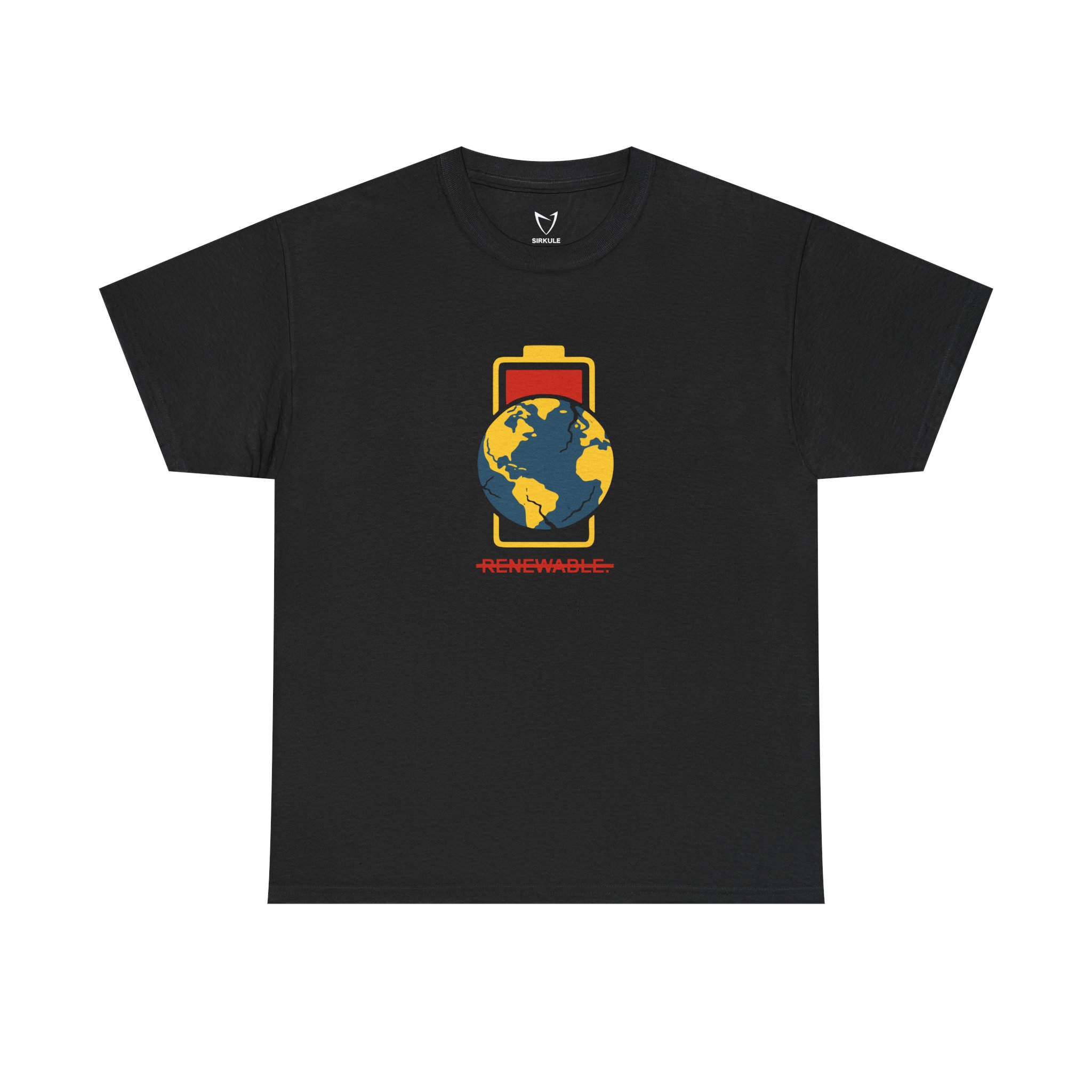
Imagine a battery.
Not the small kind you swap in a
television remote.
A large one, scaled to hold all the
energy a civilization needs.
Yellow, solid, it looks strong.
And inside that battery, enclosed in its tidy
casing, is the Earth itself, fine cracks already
visible across its surface.
But because it's wrapped, because it's sealed neatly
in clean packaging, the cracks can't be seen
from the outside.
And at the top of the battery, the
charge indicator glows red.
Not full, not being recharged, just being used,
continuously.
Below it, one word is crossed out.
Not erased.
Crossed out in a way that keeps it
legible, because something crossed out is actually harder
to forget than something never written.
Renewable.
Crossed out.
Not because the word is wrong, but because
it has been used too often to close
down questions that should remain open.
To end conversations that should keep going.
To make us feel the problem is resolved,
when all that's been resolved is the way
we name it.
Solar energy is genuinely renewable.
Wind is genuinely renewable.
But the land excavated to build the panels
is not.
The water drained to process the minerals is
not.
The ecosystems displaced to construct the infrastructure are
not.
And the children whose small hands dig cobalt
in dark mines, the childhood hours they will
never recover, that clearly is not.
There are many things within the systems we
call renewable that cannot be renewed at all.
And we choose, with full awareness, not to
include those things in the definition.
Amara didn't tell many people any of this.
Not because she was hiding it, but because
she was still in the process of understanding
what she was supposed to do with the
understanding.
Her sustainability report was eventually completed.
Small changes in a few sections, footnotes added,
one paragraph about supply chain challenges that hadn't
existed in the early draft.
The changes weren't revolutionary.
They wouldn't transform the system overnight.
But there was one sentence she added to
the conclusion, a sentence that almost didn't survive
the team review, but finally remained.
A meaningful energy transition is not only about
replacing sources, but about asking honestly what the
true cost of each replacement actually is.
No one commented on that sentence specifically.
But it was there.
And something that is there cannot be completely
ignored.
Amara didn't know whether the world would change.
She knew the statistics well enough to understand
that the path we were on remained far
from what was needed.
But she knew one thing she had learned
from the older woman on the guest house
porch, from the site manager who went quiet
too long before answering, from the 43-page
document that had kept her awake.
Words that are not honest don't solve problems.
They only postpone them while giving us permission
to feel we care enough.
And feeling we care enough while the roots
remain untouched is one of the most dangerous
forms of not caring at all.
Not everything labeled renewable is meant to be
endless.