
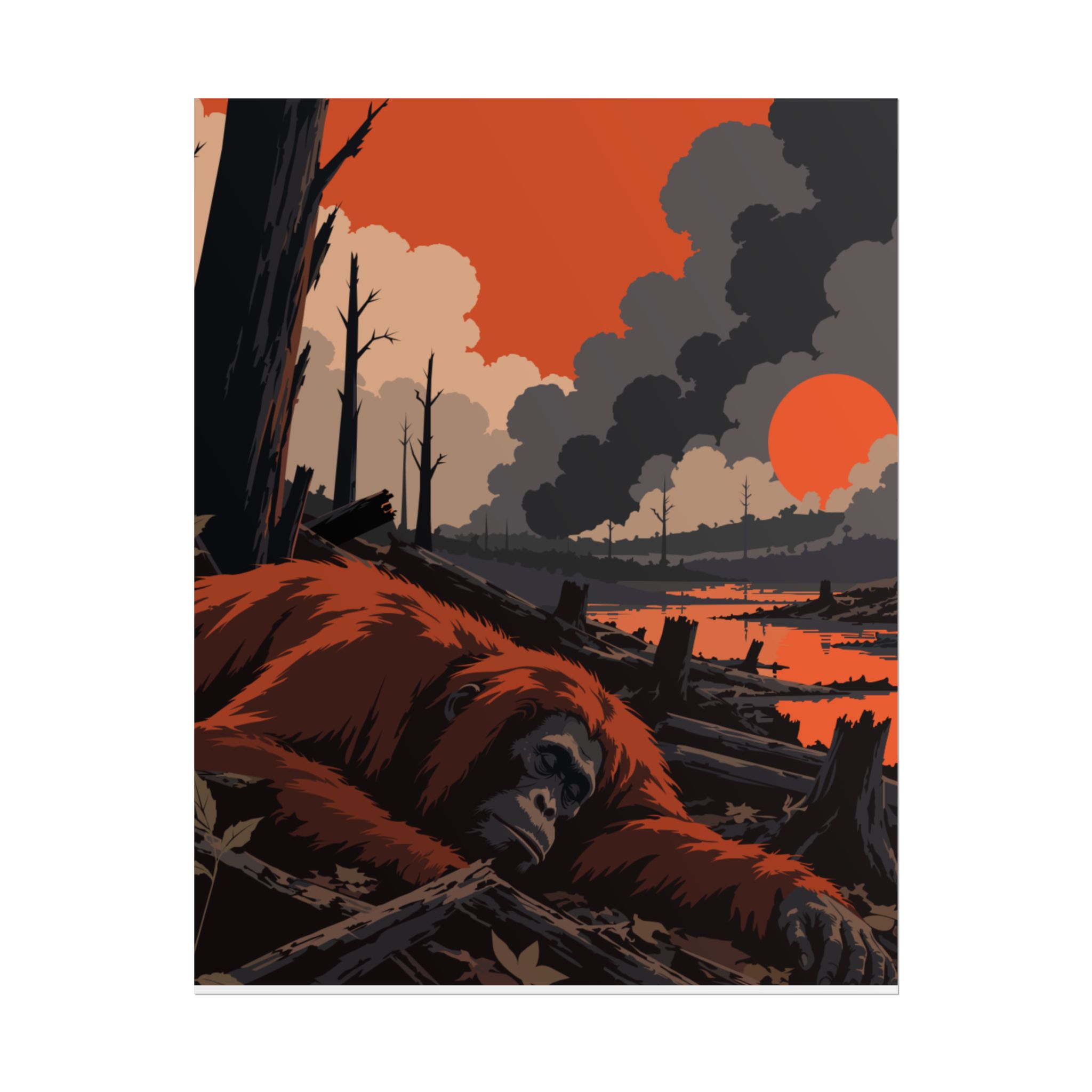


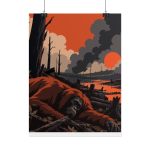
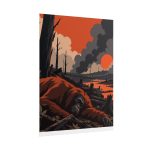

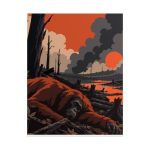
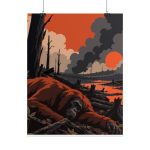


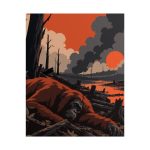


The Last One To Close Her Eyes Poster
THE LAST ONE TO CLOSE HER EYES
— A Story About the Last Orangutan of a Forest That Burned Without Anyone Watching —
Some things disappear loudly.
A fire in dry grass roars. A falling tree cracks across a whole valley. Loss like that has an edge you can point to, a date, a headline, a before and an after.
But some things disappear without any sound at all.
Like the last of her forest, walking through a place that no longer resembles the place she was born, not knowing that she is the last, because knowing requires someone to have counted. And no one was counting.
That kind of loss leaves no rubble. No announcement. Only a silence that arrives a little at a time, too gradual to be called a disaster, too certain to be called a coincidence.
✶ ✶ ✶
I.
She had no name. Names are what people give to the things they expect to keep, and no one had ever expected to keep her. She was simply born, in the crown of a tree so tall that the ground beneath it was only a rumor.
Her mother carried her for the first years of her life, and in those years the whole world was a warm chest and the swaying of branches. The forest was not a place. It was everything. It was the sound of rain arriving in the canopy long before it reached the leaves, the sweet weight of ripe figs, the smell of durian drifting for a kilometer before any of them found the tree.
Her mother taught her without ever teaching. Which branch would hold and which would not. Which fruit came in which season. How to fold green branches into a platform, layer by layer, and lie down on it as the light went out. Every night, a new nest. Every night, a small house built in the dark, then left behind in the morning as if it had never mattered.
At dawn, the males sent their long calls across the forest, a slow, rising groan that rolled over the treetops like weather. She would lie half-awake in her nest and listen, and somewhere inside her a small certainty would settle: that the forest was large, and that she was not alone in it.
She grew. Her mother grew old and one season did not come back to the fruiting trees. The other females drifted, one by one, to parts of the forest she could no longer reach. The dawn calls came from farther away, and then from fewer places.
She did not think of this as loss. It was only how the forest felt now. A little more room. A little less sound.
II.
The dry season came earlier that year, and stayed longer.
First the streams grew thin. Before the smoke, there was a sound she had never heard: engines at the edge of the forest, and the slow crack of trees that were not falling on their own. Then came the ditches, long straight scars that drained the water from the ground. Then the air changed. A smell that did not belong to the forest, drifting from very far away, sharp and sour, like something old being cooked. The sky, which for her had only ever been a scatter of light between leaves, began to turn a dull orange in the mornings.
She did not know the word fire. Nothing in her mother's teaching had prepared her for it. What she knew was that the birds had gone quiet. The gibbons that used to argue in the fig trees had left. Even the insects, whose hum had been the floor of every sound she had ever heard, had thinned into something too faint to count on.
She stayed in the tall trees and ate what she could find. Every night, she built her nest. Every morning, she woke to a sky a shade darker than the one before.
III.
Then the smoke came down into the canopy and would not leave.
It stung her eyes and thickened her breath. She moved from tree to tree by memory, hand over hand, testing each branch the way her mother had shown her. But branches she had trusted for years were suddenly warm. Some had gone brittle. One broke beneath her weight and she caught the next one with a single hand, hanging, heart hammering, while below her the ground glowed faintly through the haze.
The forest she knew was going, in pieces. A whole grove of trees she had eaten from every season stood black and open, their leaves gone, their fruit gone, their branches reaching upward like hands that had forgotten what they were reaching for.
She called out once, in the low voice her mother had used. She did not know what she expected. There was no answer, and the absence of an answer told her something she was too tired to understand: that the ones who might have replied were no longer there to reply.
That night she reached for leaves to build her nest and found only ash on her fingers.
IV.
Somewhere in the second week she came down to the ground.
She had not touched the earth in years. It felt wrong under her hands, warm and loose, giving way like something hollow. The land was covered in fallen trunks and blackened stumps, and the air above it shimmered with a heat that made the horizon shake. Trees that had been giants in her life were reduced to short broken teeth.
She walked the way her kind walk on the ground, slowly, heavily, knuckles pressed into the ash. Each step raised a small cloud that settled back on her fur. Her red coat, which had once glowed in the green shade like a lantern, was now dulled by soot until it looked almost the same color as the sky.
She followed the only thing she could still trust: the faint smell of water.
V.
By the time she reached the edge of the river, her eyes had almost closed.
The smoke had done it slowly. First a sting, then a blur, then a heaviness in the lids that she could no longer lift. The world narrowed to a red glow behind her eyelids, warm and wide and strangely calm. She was not afraid. She had gone past fear somewhere back in the trees.
But she kept moving.
That was the thing no one would ever know. Her eyes were closed, and still she moved. She dragged herself over the fallen trunks, across the broken ground, one arm reaching forward, then the other, following the sound of water with a body that had learned the forest so completely it no longer needed sight to keep going. Her hands remembered how to search for a branch. Her chest remembered how to breathe in rhythm with the trees that used to hold her.
Only the trees were no longer there.
The river lay ahead of her, dark water turned orange by a sun the color of an ember. She could hear it. She could not see it. She moved toward it anyway, the way you walk through a house in the dark where you have lived your whole life.
VI.
She stopped a short distance from the water.
Not because she had reached it. Because her body, after all the branches and all the nights, had finally reached the end of what it could carry.
She lowered herself onto the fallen trunks, among the stumps, in the last of the light. One arm stretched out in front of her, hand open, the way it had once stretched toward her mother. The sun hung low above the smoke. Its color was the same as hers.
It was time to build a nest. That was what every evening asked of her. She had no tree. She had no branches to fold, no leaves to layer. So she did the only thing left: she lay down on the ground itself, and let the ground be the nest.
Her breathing slowed. The red behind her eyelids deepened, and dimmed, and dimmed.
Somewhere far off, in a forest that no longer existed, a long call rose at dawn and rolled over the treetops. She did not hear it. She only remembered that it had once been there.
Then, without any sound at all, she stopped.
VII.
They found her two days later.
A rescue team, walking the burned land, looking for something else. The smoke had thinned that morning, and the river had dropped, and in the flat light they came across a shape lying among the stumps.
She looked as if she were sleeping. That is what every one of them said, quietly, to the person nearest to them. Her eyes were closed. Her hand was open. The fur on her shoulders was the same deep red as the sky behind her, and for a long moment no one could tell where the animal ended and the sunset began.
Someone photographed her. Someone else radioed in the news. No one knew her name, because she had never had one, and no one could say with certainty how many others there had been. The record showed only that a survey years earlier had counted many in that forest. The record now showed none.
It was not a dramatic ending. It did not come with a sound. It was only the final entry in a list that no one had been reading.
One hand lit the fire. Many hands made it worth lighting.
✶ ✶ ✶
Extinction does not always arrive the way it does in textbooks. There is not always a meteor, not always a single moment that can be marked as the line between before and after.
Sometimes it comes as a series of dry seasons. Sometimes as a road, a clearing, a field, a fire, each with its own reasonable explanation. Sometimes it comes as one animal, walking through a burning place with her eyes closed, still moving, still following the sound of water, still trying to build one more nest.
Many, then few, then one. In her forest, at least.
Her kind is not gone yet. That is the difference between a story and a warning: in a story, the ending is already written. In the world, it is not.
What is loudest is not the sound of its going. What is loudest is the silence afterward, the silence we fill with our own noise until we forget that, somewhere, a long call used to rise at dawn and now does not.
"The forest did not scream when it burned.
It only lost, one by one, the ones who could answer."
THE LAST ONE TO CLOSE HER EYES / SILENT EXTINCTION