



WHAT LEAVES WITHOUT SOUND.<break
time="1.6s"/>
A Story About Things That Disappear
Before We Have a Chance to Say Goodbye.
Some things disappear loudly.
A falling tree cracks in a way that
carries for miles. A collapsing building
leaves dust that hasn't settled for
weeks. Loss like that is easy to remember
there is a moment to point to, a before
and an after, a clear border between when
something was there and when it no longer
was.
But some things disappear without any
sound at all.
Like the particular way afternoon light
used to fall across a meadow that is now
a housing complex. Like the name of a
bird that was always there in childhood
ears but hasn't been heard in years. Like
the number of stars visible to the naked
eye from a backyard now half of what it
used to be, but nobody mourned the half
that went missing because nobody noticed
when it left.
That kind of loss leaves no rubble. No
headlines. Only a small emptiness that
expands slowly, too gradual to be called
a disaster, too certain to be called
coincidence.
Her name was Dara. Twenty-six. She worked
as a freelance wildlife photographer,
which meant her job was to go places most
people didn't go and capture things most
people never got to see.
She chose this work not for the romance
of adventure. Not because the images she
made looked good in galleries or on
magazine covers. But because of a day in
her childhood she couldn't remember
exactly how old she was when her father
took her to the edge of their garden at
the border of the forest, and between the
bushes, she saw a deer standing still,
looking at them.
Two seconds. Maybe three. Then the deer
turned and disappeared back into the
trees.
There was nothing remarkable about that
moment, if told to someone else. But Dara
carried it the way you carry something
fragile — carefully, for years all the
way to the day she chose a camera as her
tool and the forest as her address.
Her father never knew that a deer had
chosen a career for his daughter.
The assignment came from an international
conservation organization. Not a large
one no big budget, no famous names
involved. Just a simple request: go to
East Africa, join a field team, document
the condition of the remaining white
rhino population in a protected area that
hadn't received media attention in three
years.
Dara accepted without many questions.
What she wasn't prepared for was what she
would find there.
The field team was led by a man named
Joseph. Fifty years old. Twenty-three
years working as a ranger in that
territory, from the time when the number
of rhinos in this area could still be
counted on two hands to now, when the
number could be counted on the fingers of
one.
Joseph didn't say much on the first day.
He simply walked, and Dara followed
through brush taller than their heads,
across small rivers with water still
clear, across tracks in the soil that
Dara couldn't read but that Joseph read
like sentences from a book he knew by
heart.
They didn't find any rhinos that day.
But they found something else: a
footprint last pressed into the mud three
days ago, by Joseph's estimate. Large.
Deep. Still clear enough to photograph.
Dara photographed that footprint for
longer than documentation strictly
required.
On the first night at camp, Joseph made
tea from a thermos that looked like it
had accompanied him longer than the
duration of most people's marriages.
They sat outside the tent. The sky here
was different from Jakarta, from Bandung,
from any city Dara had lived in a sky
that felt larger than should
geometrically be possible, filled with
stars that didn't compete for space.
"How long have you been a photographer?"
Joseph asked.
"Four years.".
"Photographed rhinos before?".
"No. This is the first time.".
Joseph nodded. Nothing was commented on
from that answer. He sipped his tea.
"When I first came here," he said after a
while, "there were twelve in this
territory. Now there are four.".
Dara didn't answer. She had read the
number in the briefing. But hearing it
spoken by someone who had counted it
himself, who knew each one by a name he
had given them, felt different from
reading a figure on a PDF page.
"The oldest is named Amara. Female. About
forty years old. In normal conditions,
rhinos can live to fifty.".
Joseph paused.
"But conditions are not always normal.".
On the third day, they found Amara.
She stood at the edge of a small river
whose water was beginning to recede. Her
body was large and still, undisturbed by
their presence though Dara was certain
she knew they were there. Her skin was a
dark grey that looked like very old
earth, with wrinkles and folds that each
felt like the travel notes of everything
she had ever been through.
Dara raised her camera.
But didn't photograph immediately.
There is something that happens when you
stand close enough to a living thing that
is this old, this large, and this quiet
something that can't be explained by
technical words about composition or
lighting or angle. Something closer to
reverence than anything Dara had felt in
front of a subject before.
Amara drank from the river. Slowly.
Without hurry. Like someone who is very
old and very tired but has not yet lost
the belief that tomorrow is worth waiting
for.
Dara pressed the shutter.
And inside her camera's viewfinder, she
saw something she wouldn't find in the
finished photograph: at the edge of
Amara's body, on the shoulder facing the
afternoon sun, a few pixels of the image
felt like they would disappear if not
captured right then.
She knew that made no technical sense.
Cameras don't work that way.
But the feeling wasn't wrong.
Joseph told her about the others that
night.
About Kesi, a young male found dead two
years ago, injured by a trap set not by
professional hunters but by local
residents whose crops had been destroyed
and who knew no other option available to
them. About Ora, an older female who
disappeared for three weeks before being
found at the southern edge of the
territory, already too weak to walk back.
About two others not given names in
Joseph's telling, referred to only as
"the first to go" and "the second" found
in conditions he didn't need to describe
in detail because the way he stopped his
sentence was already enough for Dara to
understand.
Twelve to four hadn't happened in a
single night.
It became four slowly, without
announcements, without headlines. One by
one. With enough time between each loss
that no one managed to feel it as a
crisis only as a series of events each of
which seemed like inevitable fate, not
like part of a pattern that could still
be broken.
"The hardest part," said Joseph, staring
at the fire that had nearly died out, "is
when people in the city say 'what a
shame' and then move on to talk about
something else. Because for them, this is
a number. For me these are neighbors.".
Dara didn't know what to answer.
So she answered nothing. She only looked
at the same fire, and let the words sit
between them without needing a response.
On the last day before Dara's flight
home, she woke before dawn.
Not because anything required it. Not
because there was something that needed
to be photographed at that hour. Only
because something kept her from sleeping
not anxiety, not restlessness. Something
quieter than that, and heavier.
She walked to the riverbank alone. Joseph
knew she'd gone the man was already awake
before her as he was every morning but he
didn't follow. Dara didn't know whether
that was because he understood there were
moments that had to be experienced alone,
or because he had watched too many people
stand at that river's edge with the same
expression.
Amara wasn't there that morning.
Only the river. Only water moving more
slowly than the day before because its
level kept dropping. Only tracks in the
mud that would dry and disappear before
the day ended.
Dara stood there for a long time. Camera
in hand but not raised.
There are things that shouldn't be made
into photographs, she thought. Not
because they aren't worth preserving, but
because there are moments that lose
something when put into a frame when
turned into something others can see
without having to stand here, without
having to feel the same wind, without
having to hear the absence of a sound
that should be present.
She set the camera down at her side.
And stood still. At the edge of a river
that kept receding. On ground that still
held the prints of a creature that
perhaps no one would see again twenty
years from now.
Five minutes. Ten.
Not praying. Not grieving in a way that
has a name. Just present fully, without
agenda, without camera, without words.
Just present, as witness to something
that required no explanation.
VII.
In Jakarta, the photographs were
exhibited in a small gallery. Not many
came but those who came didn't leave
quickly.
There was one photograph people stood in
front of the longest.
Not the most dramatic shot of Amara. Not
the footprint in the mud. Not the
receding river or the grassland burning
in the distance.
The simplest photograph: Amara standing
at the river's edge in afternoon light,
taken from far enough that she appeared
small in the frame a large creature made
to look small not by size, but because
the landscape around her was so vast and
quiet and seemed like it would keep
existing long after she was gone.
In the upper right corner of that
photograph, very faintly, almost
invisible unless you looked for it the
part of Amara's shoulder facing the light
appeared slightly faded. Like something
beginning to dissolve into air. Like
something slowly taking its leave of a
world too busy to notice.
No editing effect. Dara hadn't done that.
Only the way that afternoon light fell on
that day, in that place, at an angle that
would never be exactly the same again.
Some people who looked at the photograph
asked whether it was intentional.
Dara always answered the same way: she
didn't know. She only photographed what
was there.
And what was there, on that day, was
something in the process of becoming no
longer there.
Extinction doesn't always arrive the way
it does in textbooks. There isn't always
a meteor, isn't always a single disaster
that can be marked as the dividing line
between before and after.
Sometimes it comes very slowly. So slowly
that no one recognizes it as a process
only as a series of misfortunes each of
which can be explained individually, each
of which sounds reasonable, each of which
doesn't feel like a step toward something
irreversible.
Twelve to four.
Four to how many, no one dares predict
aloud because the number would be too
small to write without it feeling like
the final sentence of something.
What is loudest is not the sound of its
going. What is loudest is the silence the
silence we fill with other things, with
the noise we produce ourselves, until we
forget that beneath all of it something
is leaving, slowly, without permission,
without announcement, without anyone
standing at the roadside to wave goodbye.
"The most fatal extinction is not the
loudest.
but the most silent.".
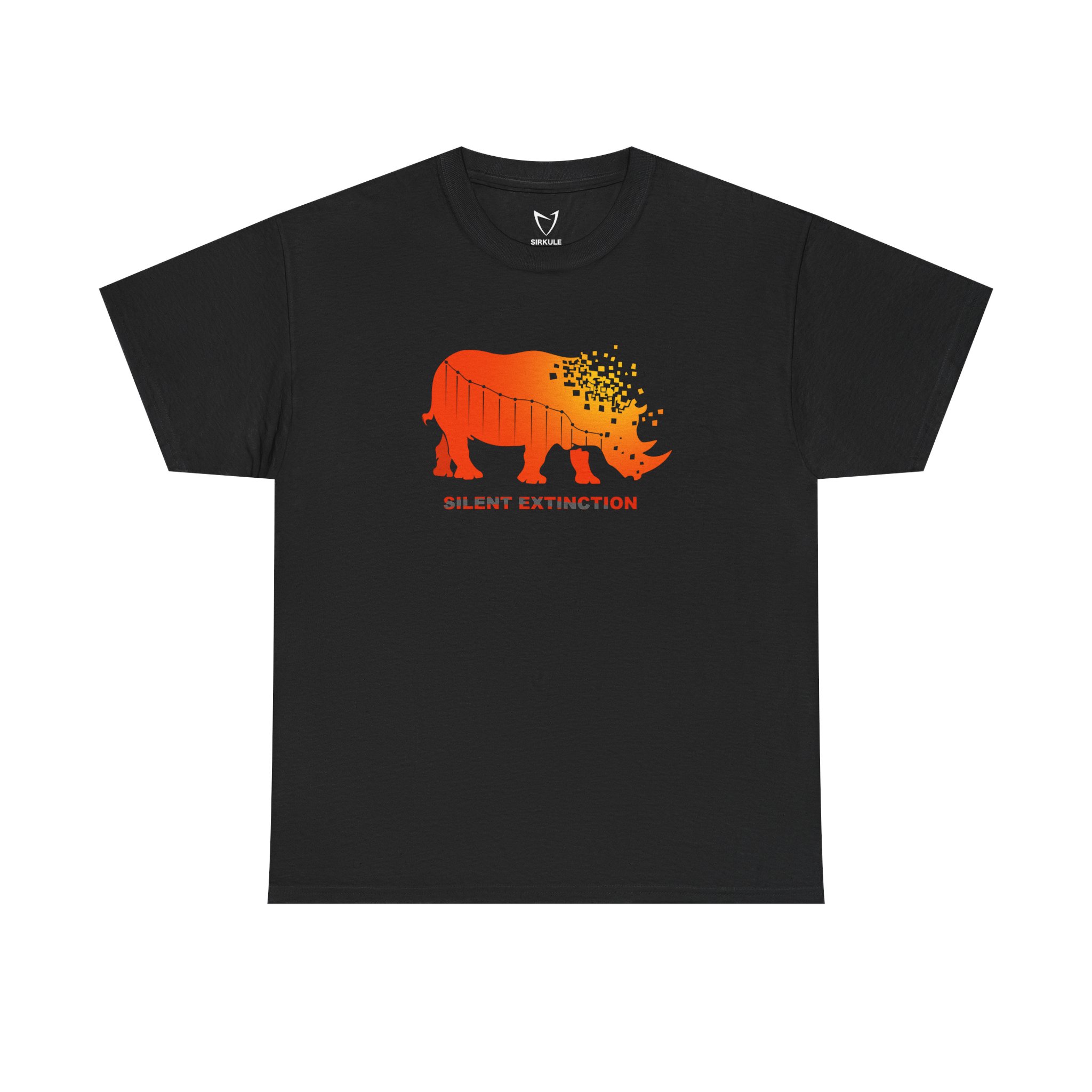
WHAT LEAVES WITHOUT SOUND / SILENT
EXTINCTION.