
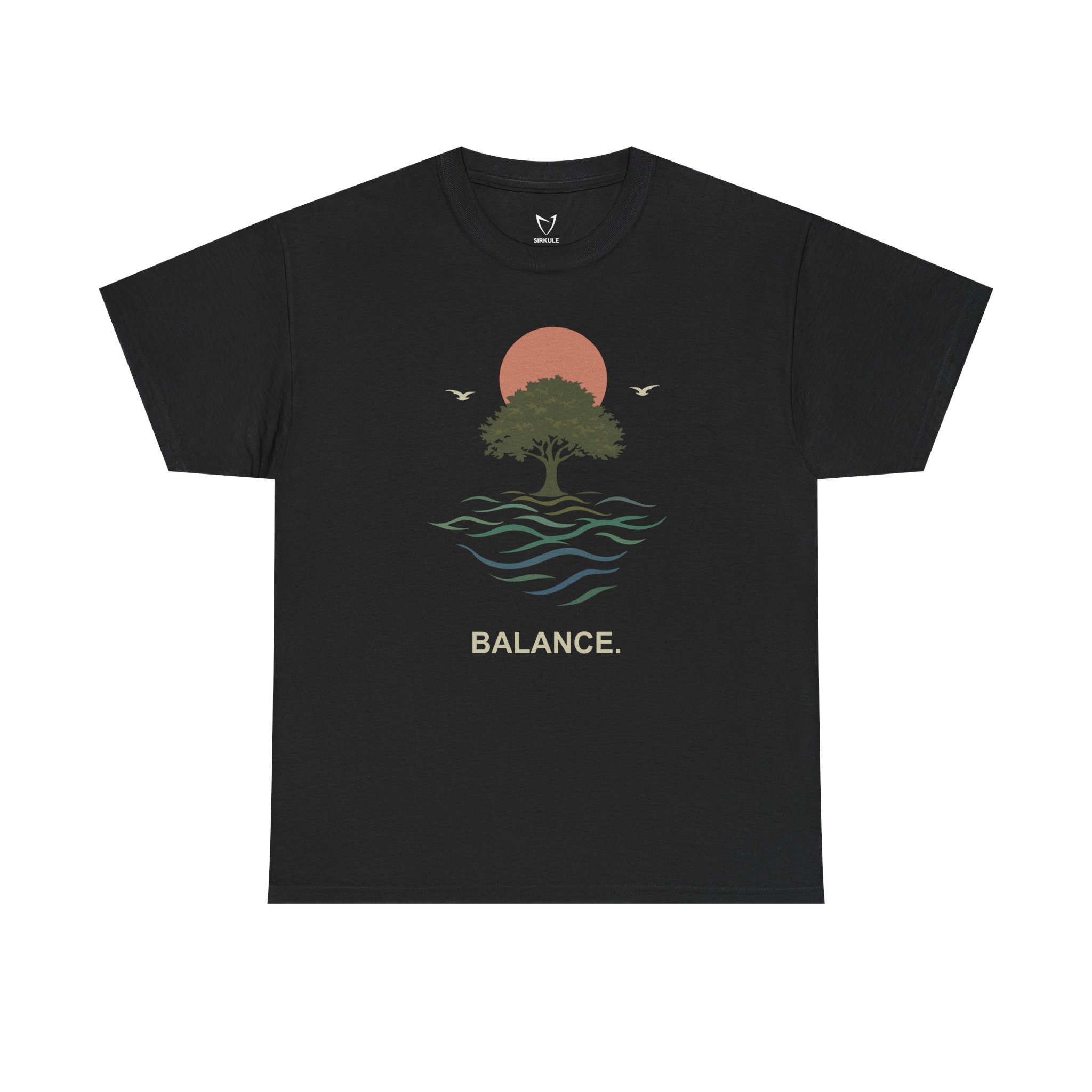




BALANCE.
A Story About What Has Always Been Here,
Before Us.
The man's name was Raden. But no one in
his village ever called him that.
Everyone called him Pak Den — an old man
who had lived in the same place long
enough that he and the land had become
inseparable. Seventy-two years. His
entire life spent on the same hillside,
among pine trees that had existed before
his birth and a small river that ran
below the garden he inherited from his
father, who had inherited it from his
father's father.
Nothing remarkable about his life, from
the outside.
He farmed. He tended his garden. He woke
before dawn and slept long after the sun
had gone down. He had been to the city no
more than ten times in his life. He owned
no smartphone until his child bought him
one two years ago — which he now used
only to make calls and occasionally look
at photos of his grandchildren.
But there was one thing Pak Den did every
morning, without exception, for more than
fifty years.
Before picking up his hoe, before brewing
coffee, before doing anything at all — he
would stand at the edge of his garden and
be still. Five minutes. Sometimes ten.
Just looking.
"What for, Grandpa?" his granddaughter
asked one morning — an eight-year-old
visiting from the city, puzzled to see
her grandfather standing motionless like
a statue.
Pak Den turned. Thought for a moment.
Then answered the way old people often
answer children's questions — not with
explanation, but with a question of his
own.
"Have you ever heard the soil speak?".
She frowned. "Soil can't speak,
Grandpa.".
"Not yet," said Pak Den. "Because you've
never been truly quiet.".
Her name was Layla. Twenty-eight years
old, an environmental consultant who had
just completed a six-month project in
Borneo — surveying the impact of
deforestation on water patterns across a
river basin.
The numbers were in the report. The model
had been built. The recommendations had
been submitted to a client who might read
them, or might not.
What was not in the report was what she
felt when she saw it firsthand — not from
data, not from satellite imagery, but
with her own eyes — a river that twenty
years ago had run swift and strong, now
reduced to a thin, brown trickle
stumbling across cracked earth.
There is no technical term for that
feeling. Reports don't include a column
for grief.
She went home to her hometown on a
hillside in West Java to rest. Not to
vacation — she no longer knew the
difference. She simply needed a few days
without deadlines, without presentations,
without numbers to explain to people who
had already decided their conclusions
before the meeting began.
Her mother told her about an old neighbor
with a beautiful garden. "Go visit him.
You look like someone who needs soil
under their feet.".
The phrasing felt strange. But Layla had
no energy to argue. So she went.
Pak Den's garden was not an ordinary
garden.
Not because of its exceptional yield. Not
because of sophisticated irrigation.
Technically, it was probably far below
modern agricultural standards — no
chemical fertilizers, no pesticides, no
genetically engineered high-yield
varieties. Everything was done the way it
had been done on this land for hundreds
of years.
What made it different was how it felt —
like a place that had never been made to
shout.
Layla couldn't put it into words at
first. But as she stepped between the
trees, something shifted. Not
dramatically. Not like in films where the
main character enters the forest and all
their problems dissolve.
Smaller than that. More real.
The air temperature was three degrees
cooler than the road outside. There was
the sound of water from a small channel
running along the western edge — not a
large flow, just a slow, cold current
carrying coolness down from a spring
above. The soil here was dark and damp
despite three dry days. And there was a
smell — the smell of living earth,
different from soil that has been pushed
too hard for too long to produce
something.
Pak Den found her standing among the
trees, looking down at the ground with an
expression he recognized.
"You're from the city — the kind who
studies forests?".
She looked up, slightly startled. "I'm an
environmental consultant.".
Pak Den nodded slowly, like someone
receiving information they had already
concluded before hearing it. "Same thing.
Sit down.".
They sat beneath an old avocado tree
whose trunk had grown wide enough to
require two people to embrace it.
Pak Den poured tea from a thermos he
always carried. He didn't speak at first.
He let the sounds of the garden fill the
space between them — wind through leaves,
distant chickens, the small chirping of
birds whose names Layla didn't know.
"Can you explain why this tree is still
alive?" Pak Den said at last, gesturing
at the avocado above them.
Layla looked up. The tree was old but
strong. Its canopy was full. Its trunk
stood straight, roots gripping the earth
like anchors. "Good soil. Enough water.
No major pests attacking it.".
"That's the answer of someone who learned
from books.".
Layla didn't take offense. Because it was
true.
"This tree is alive," said Pak Den,
"because I have never asked more of it
than it could give. That's all. No other
secret.".
Layla looked at him. "What do you mean?".
Pak Den drew a slow breath. He gazed out
over his land spreading below — plots
carefully divided, interspersed with
trees left to grow not for yield but for
shade, for roots that anchored the soil,
for the small ecosystem that kept the
whole garden healthy.
"This soil is not mine. I'm a guest here.
And a good guest doesn't take more than
their share.".
Layla said nothing. She reached for her
notebook — professional habit she could
not switch off — but stopped before
writing anything.
There was something in the way that
sentence came out that didn't fit to be
quoted in a report. Too simple to seem
significant. But for that very reason, it
felt like something she had not heard in
a very long time.
That afternoon they sat until the sun
began to descend.
Pak Den talked a great deal — or more
accurately, he talked in a way that led
Layla to ask questions she had never
asked the experts or clients or
colleagues with long credentials.
He talked about seasons. About how he
knew when to plant not from a calendar
but from the way termites built their
mounds. About how he knew when heavy rain
was coming not from a weather app but
from how the cattle below grew restless
twelve hours before.
"Nature has its own rhythm," said Pak
Den. "The same way a heart has a rhythm.
You don't need to manage it — you only
need to stop disrupting it.".
Layla thought of Borneo. Of the brown
river. Of the report she had submitted
that recommended, among other things, a
two-year logging moratorium and a
revegetation programme using native
species.
Good recommendations. Strong data behind
them. And most likely to be ignored by
those who most needed to hear them.
"Pak Den — if this garden was affected.
If the water dried up. What would you
do?".
Pak Den didn't answer immediately. He
looked toward the small water channel
running along the west. From here its
sound couldn't be heard, but he knew it
was there.
"I've been through that. Twice. When I
was younger, there were years when the
water dropped by half. My father said:
when nature is in difficulty, our job
isn't to panic. Our job is to give more
space, not demand more.".
"Meaning?".
"Plant more. Take less. Wait. Nature can
recover if it's given time. What it
usually isn't given is that time.".
Layla wrote that down. This time she did.
On her last morning in that village,
Layla woke earlier than usual.
Not because anything needed to be done.
Only because something had made it
impossible to sleep — not restlessness,
not anxiety. Something quieter than that.
She walked to Pak Den's garden without
telling anyone. The gate was unlocked.
She stepped inside and stood in the same
spot where they had sat the day before —
beneath the old avocado tree.
Dawn had not fully arrived. The sky was
still a warm shade of grey, and to the
east a thin line of orange was slowly
deepening. Below, the soil was still damp
with night dew. Above, leaves hung still
— unmoving, as if waiting.
Layla stood in silence.
Five minutes. Ten.
For the first time in a very long time,
she wasn't thinking about reports. Wasn't
thinking about numbers. Wasn't thinking
about the next presentation or the
projects already queuing in her inbox.
She was simply here. Between soil that
was still healthy and air that was still
clean and a tree that had been alive
longer than she could remember.
And for the first time in an equally long
time, she felt something that had no
technical name in any of the reports she
had ever written.
Something that felt like: this can still
be kept.
Pak Den found her still standing there
when he arrived to begin his routine.
They didn't say much. Pak Den simply
stood beside her for a moment, looking in
the same direction — east, toward the sun
now half-risen above the horizon, round
and red the way it appears in old
paintings.
"Going back to the city today?".
"Yes.".
"Taking what with you?".
Layla thought. "A report. A laptop.
Clothes.".
Pak Den nodded. "And?".
Layla turned. Pak Den was watching her
with eyes that had seen too many seasons
to be fooled by an answer given too
quickly.
"I think," said Layla finally, "I'm
taking a reminder.".
"A reminder of what?".
"That nature doesn't need us to be in
balance. What needs balancing is us — so
we remember our place within it.".
Pak Den was quiet for a moment. Then he
nodded — not the way someone nods to be
polite, but the way someone nods when
they hear something they have known for a
long time but rarely hear others say.
"I've been waiting a long time for
someone from the city to say that.".
Something is wrong in the way we define
progress.
We measure it by what we have
successfully added — more buildings, more
production, more connection, more speed.
But we rarely measure it by what we have
successfully preserved.
Balance is not a condition that can be
created. It is not a project that can be
completed, not a target that can be
reached and then left behind. It is an
ongoing process — and the only role we
have within it is not to control it, but
to stop endlessly violating it.
Nature already knew how to balance
itself, long before humans existed. The
sun rises and sets. Water rises to the
sky and falls back to earth. Roots hold,
soil stores, seasons turn. All of this
runs not because someone manages it — but
because not enough has disrupted it yet.
What we can do is not make that balance.
What we can do is only respect it.
"Balance isn't created. It's respected.".
BALANCE. T-SHIRT.
Black. Grounded. Aware.
For those who still remember the earth is
not ours — we are only guests here.