


(Sirkule by Nazhak.) What Never Left, a story about the small
things we leave behind and how they wait.
Plastic is convenient.
That's not an accusation.
It's a fact we've accepted for a long
time, the way we accept that the sun
rises in the east or that rain falls
downward.
Plastic is everywhere, not because of some conspiracy,
but because it genuinely answered a real need.
Cheap.
Lightweight.
Durable.
Moldable into almost anything.
Too durable, as it turns out.
But this isn't a story about industry or
policy.
This is a story about a woman named
Sarah and a sea turtle she never met.
Sarah grew up on the coast, not in
one of those trendy seaside towns with Instagram
-worthy sunsets and overpriced coffee, but in a
small fishing village on the coast of Java,
where the sea wasn't a view but a
livelihood, where her father came home before dawn
smelling of salt that never quite washed off
his hands.
As a child, Sarah used to sit at
the edge of the wooden pier, dangling her
feet into the water.
The water was clear.
She could see the bottom, small stones, fish
that darted away from her shadow, and sometimes
a jellyfish drifting through like an unfinished dream.
Her father used to tell her about sea
turtles.
Back when I was your age, turtles would
come up onto this beach.
At night, when the waves were gentle, they
weren't afraid of people then.
Sarah asked why they didn't come anymore.
Her father was quiet for a long time.
Then he just nodded toward the sea, toward
something Sarah couldn't see, something beneath the surface.
They're still out there, he said, but the
ocean is different now.
Twenty years later, Sarah was working as a
freelance documentarian for an environmental NGO.
Her job was simple, go to the places
no one was paying attention to and make
the world care.
Easier said than done.
One week before her assignment to the Banda
Islands began, she received a photo from a
colleague in the field, not a photo she
had requested, just one that was sent because
the sender didn't know who else to tell.
A sea turtle had been found on the
beach, dead, its stomach open, not by a
predator but by a veterinary team trying to
understand why.
Inside its stomach, 83 pieces of plastic, grocery
bags, straws, shards of bottles, food wrappers, all
of it intact.
Because plastic doesn't decompose, it only changes shape,
smaller and smaller, less and less visible, deeper
and deeper into bodies that never chose it.
Sarah stared at the photograph for a long
time, then she closed her laptop, then she
opened it again because she couldn't stop looking.
There was a question she knew the answer
to but didn't want answered.
Which plastic?
From where?
Belonging to whom?
The question hung in the air because the
answer was uncomfortable, it could be from anyone.
From someone rushing through a market who didn't
have time to think about a bag.
From someone who tossed a bottle out a
car window because there was no bin nearby.
From someone, maybe Sarah herself, on a different
day, in a not so different life.
Plastic doesn't carry a signature, it simply exists,
and once it exists, it doesn't leave.
That is what the human mind has never
truly grasped.
Something that cannot be seen does not mean
it isn't there.
We discard and we forget, but what we
discard does not forget.
In Banda, Sarah met an old fisherman named
Rustam.
70 years old, his eyes still sharp the
way people's eyes get when they've spent a
lifetime looking far.
At the horizon, beneath the surface, at things
others miss.
He didn't speak much, but when he did,
every sentence felt like a field note collected
over half a century.
The sea has memory, he said one afternoon
as they sat beside a boat that hadn't
gone out for months.
It doesn't forget what you give it.
Sarah wrote that sentence in her notebook, not
for the article.
For herself, Rustam continued, his eyes still on
the water.
This sea used to be full of life,
it still is, but you can feel it.
It's tired, like someone who's been sick a
long time but hasn't been given permission to
rest.
Sarah didn't know what to say, so she
said nothing.
She just sat and let the words sink
somewhere deeper than thought.
That night, Sarah walked alone to the beach.
Half a moon, slow waves, sand that felt
different under her feet, coarser than she remembered
from childhood, though perhaps that was only her.
At the water's edge, she saw something washed
ashore.
Not a turtle, not a fish, a clear
plastic bag, half filled with water, expanding and
contracting with the tide, like a living thing
breathing.
From a distance, in the dim light of
the moon, it looked exactly like a jellyfish.
Sarah picked it up.
There was nothing significant inside, just seawater, just
fine sand, just one more object that would
never truly disappear.
Only travel, only shrink, only enter a chain
that has no end.
She stood there for a long time, wind
off the sea, the sound of waves that
didn't stop, and in her hands a piece
of plastic that had perhaps traveled farther than
she could imagine.
From an open bin to a gutter, from
a gutter to a river, from a river
to the ocean, from the ocean to here.
Never stopping, only moving.
Sarah returned to the city two weeks later
with hundreds of photographs and one question she
didn't include in her report.
When exactly did we decide that, out of
sight, meant finished?
Because the plastic we discarded 30 years ago
is not finished.
It still exists, in microscopic fragments in our
drinking water, in the fish we eat, in
the bloodstream of newborns who have never once
held a plastic bag.
We are leaving behind an inheritance we never
planned to leave.
And what's most frightening isn't the damage itself.
It's how normal all of this feels.
How easily we accept a new plastic bottle,
open it, drink from it, and set it
aside without finishing the thought of where it
will go.
At her office, someone asked, if just one
person changes their habits, does it even matter?
Sarah didn't answer right away.
She thought about Rustam, about the turtle, about
the plastic bag that looked like a jellyfish
under moonlight.
Eight billion people who each believe one person
doesn't matter, she said finally, is exactly why
we're here.
The person nodded, though Sarah wasn't sure the
message had landed.
That was fine.
Messages don't have to arrive in a single
conversation.
What matters is that the conversation happens, and
keeps happening, and doesn't stop.
Sarah couldn't save every sea turtle, couldn't clean
every ocean, couldn't reverse 40 years of global
habit in a single movement.
But she could choose, today, tomorrow, and the
day after.
Not out of optimism, but because not choosing
is also a choice.
And it's a choice we've been making for
too long without realizing it.
The ocean doesn't shout.
It doesn't march.
It doesn't file a petition.
It simply holds everything.
Every object we throw in, it receives.
Every wound we leave, it carries, with a
patience that we should never mistake for permission
to keep doing nothing.
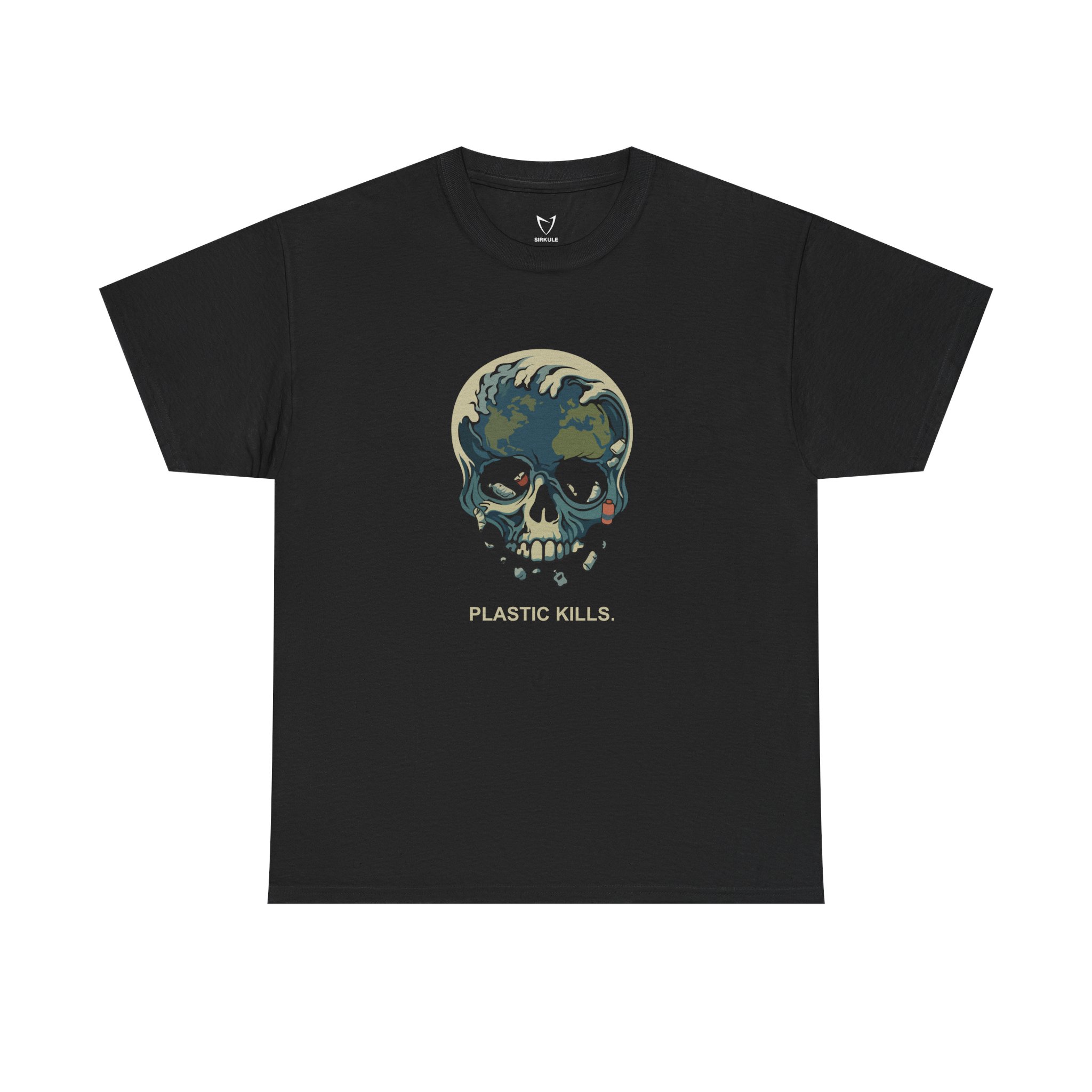
This earth is like a face slowly losing
itself, not in one blow, but in thousands
of small decisions treated as unimportant, until one
day we stand before it and no longer
recognize what we're looking at.
The turtle never knew the word plastic.
It only knew, this looks like food.
And it ate what was there.
We know the word.
We know where it comes from.
We know where it goes.
And still, every day, we choose to forget.
It doesn't disappear.
It stays.
In the ocean.
In the ground.
In us.